"Sanctification is obedience, and, as a progressive thing, consists in obeying God more and more perfectly. Young converts should be taught so as to understand what perseverance is. It is astonishing how people talk about perseverance. As if the doctrine of perseverance was "Once in grace, always in grace," or "Once converted, sure to go to heaven." This is not the idea of perseverance. The true idea is, that if a man is truly converted, he will continue to obey God. And as a consequence, he will surely go to heaven. But if a person gets the idea that because he is converted, therefore he will assuredly go to heaven, that man will almost assuredly go to Hell." - Charles Grandison Finney "Instructions of Young Converts in Lectures on the Revivals of Religion".

Friday, October 10, 2008
"Once Saved, Always Saved" heresy refuted by Charles Finney
Right now I'm doing an essay on Charles Finney's Lectures on Revivals of Religion, it's mostly how Americans tend to anthropomorphize God into an image of themselves, etc. (You know those Canadian profs). Finney was a Baptist Preacher, Abolitionist, and the founder of Evangelicalism's greatest weapon: "The Altar Call" and anxious seat manuevers, yes this is the man who destroyed the Monergism of historic Protestantism. But I found one passage I like, he lets loose on the popular twisting of Calvin's doctrine of perseverance. This is the detestable heresy known as 'Once Saved, Always Saved'. I've found it everywhere -even Capernwray- but to throw the Mennonites a bone here, they reject it (one of their few but notable successes). I'll let Finney do the talking from here out though:

Wednesday, October 8, 2008
Who Obscured Scripture - Luther or the Medieval Church
Much like the assumption of Catholics that Protestants will scream when doused with Holy Water, there is another myth coming from the other side. I would argue that this myth has so pervaded Protestantism that their historians have spread it even unto the academic world. Today I encountered it.
It is the great Protestant myth that the Catholic Church is somehow 'scared' of the Bible. It is a natural assumption of most people, that the Protestant Reformation saved the bible from the ashes. This is a lie. Over 100 editions of the Bible were produced by the Catholic Church in the 50 years preceding the Reformation in the vernacular languages (spoken or common languages) of the people. Martin Luther produced one, which the Church forbid -as it did with Wycliffe's because it was an improper translation, Luther added 'alone' to Eph 2:8-9, and other such disfigurements of the word of God as preserved by the Catholic and Orthodox Church.
People complain about the 'Vulgate' - the Latin Bible being used, and that it's purpose was to 'hide' the bible from commoners in a foreign language. The name Vulgate is interesting because it comes from the same english root as Vulgar - meaning in the common speech of the people.
Here is an amazing article showing that this Protestant Myth is just that - a myth - and not a fun myth like Lord of the Rings, or a true myth like Gen 1-3, but a fake bad myth.
here it is: (thank you Lord for Dave Armstrong)
"because of the human tendency to dichotomize differing viewpoints and to create "good guys" and "bad guys" in the most sweeping terms, it becomes almost "psychologically necessary" to come up with a villan, historically-speaking. If Protestants are for the Bible, then (in this mindset) someone has to be the "bad guy" and against the Bible. Therefore, in a movie of this sort, which deals with the myth and folklore of Protestant origins, the Catholic Church "must" be the "bad guy" and enemy of the Holy Scriptures (otherwise, much of the Protestant self-understanding and historical importance and rationale for the very movement itself is greatly hindered). Alongside this is the commonly-held Protestant caricature of claiming that the Catholic Church "feared" the Bible, and how it would expose the falsity of Catholic beliefs, which is why she allegedly forbade it to the common people, in the common tongue, and discouraged its study.
The only problem with such embellishment of one's own epic and noble tale of origins is that it can't hold a candle to the true history concerning the Catholic high reverence for Scripture. It is a simple, indisputable historical fact that the Catholic Church was the guardian, translator and preserver of the Bible for the nearly 1500 years between the time of Jesus Christ and Martin Luther. Anyone at all familiar with the Middle Ages knows about learned monks copying the Scriptures laboriously by hand.
Had the Catholic Church hated or feared the Bible as is so often absurdly claimed, it was an easy matter during this period to destroy all copies. Nor were the masses ignorant of the Bible in the Middle Ages before the Protestants came into the picture. If anything, Bible literacy in the fifty years before Luther's revolt (1467-1517) among lay non-scholars was arguably greater than in our own time.
Before the modern printing press was invented in the mid-15th century, Bibles were chained at libraries not in order to "keep them from the people," as the stereotype goes, but rather, to protect them from thieves, so the common people could have more access to them, as books were very expensive. This practice persisted long after 1517 in Protestant countries such as England, since older books would have continued to be very valuable. Every Protestant (even the most anti-Catholic sort) ought to be profoundly thankful to the Catholic Church, without which they would not possess their Bible.
Nor is it at all true that the Catholic Church was opposed to the printing and distribution of Bible translations in vernacular languages (it did oppose some Protestant translations which it felt were inaccurate). For instance (utterly contrary to the myths in this regard which are pathetically promulgated by the movie Luther), between 1466 and the onset of Protestantism in 1517 at least sixteen editions of the Bible appeared in German, with the full approval of the Catholic Church:
High German:
Strasburg: 1466, 1470, 1485
Basel, Switzerland: 1474
Augsburg: 1473 (2), 1477 (2), 1480, 1487, 1490, 1507 [also in 1518]
Nuremburg: 1483
Low German:
Cologne: 1480 (2)
Lubeck: 1494
Halberstadt: [1522]
Delf: [before 1522]
(From Johannes Janssen, History of the German People From the Close of the Middle Ages, 16 vols., translated by A.M. Christie, St. Louis: B. Herder, 1910 [orig. 1891], vol. 1, 56-57, vol. 14, 388)" - Dave Armstrong in a Response to the movie "Luther" http://socrates58.blogspot.com/2004/05/catholic-response-to-movie-luther-2003.html
Roman Fire Upon These Profs!!!@#$@%@#%!!!
WARNING: This is an inflamatory piece of Catholic Rhetoric that was written in anger to all the Protestant Rhetoric I've had to read at university. Do not expect objectivity. Probably only Philip Wilson will enjoy this post.
It seems in life that one of two things is happening to me:
1) in an andrew-centric cosmos all effort is being thrown against him and thus last year he was almost overwhelmed by Atheist Profs, and this year by Mennonite Profs
or
2) Andrew is paranoid
I'm choosing 1.
This year at Brock it would seem that the heresy train has arrived before the atheist train and thus all of my Profs are what I like to call 'ignorant Protestants' - PLEASE NOTE - this category excludes Traditional Reformed, Lutheran, and Anglican Protestants who actually understand history and Catholicism for the most part. At least these people hold the 'catholic' faith (http://www.creeds.net/ancient/nicene.htm), unlike the Anabaptists.
But it would seem that Munster has been so overrun with garbage that they had to send some to Brock. I have 3 highly 'Evangelical' Mennonites, spreading the good news of 'Papist Evils', and the beauty of the late Dr. Martin Luther, clinically depressed schismatic, responsible for the greatest divisions in Church history, thus making him a Protestant saint.
Today I sat through a world religions lecture where Menno-Prof 1 - who was Liberal Theology Prof last year - waxed theological about how Catholics don't believe in salvation by grace alone (a strange claim as they invented the phrase "grace alone conquers sin" St. Augustine), and that they believe that salvation is through ALL 7 sacraments and the Pope. How on earth any individual could recieve all seven sacraments, I have no idea - it would certainly be tricky to be ordained a Priest with a vow of celibacy and be married to someone... I also apparently missed the part in the Catechism's treatment of salvation where wthe Pope directly saves people, but check for yourselves: http://www.scborromeo.org/ccc/p3s1c3a2.htm
We also had to sit through 3 U2 Songs to show us the 'beauty of protestant music'.
The only fact that he got right was when he said 'If you ever go to a Non-Denominational Church, it is just a Protestant Church disguised as something completely Christian and that alone'. Amen...
So what's wrong with Mennonites? you might ask: (I was hoping you would)
the following are a list of heresies prevalent in the Mennonite Tradition
-Credobaptism/Zwinglian view of baptism (see nicene creed - forgiveness of sins, not symbolic)
-Sola Fide (James 2:24)
-Sola Scriptura (1 Tim 3:15)
-Mariadelendaology (Mary hatred, delenda - is to destroy in latin)- my own latin invention for
the opposite of the heresy of Mariolatry (Mary worship). Menno Simmons actually taught
(arguably, as there is only one source) that Jesus was born through Mary's side (How Buddha
was born), and not in the natural way, and that Jesus wasn't actually any part of Mary, this is a
strange heretical mix of Buddhism with a special medieval protestant twist of hatred to women
(see John Knox) in that they are inherently dirty and unclean, and that no saviour could pass
through their _____. (Gen 3:15, 1 Jn 3:8)
-Priesthood of all believers/Congregationalism/idiots leading the church - I think one of the greatest heresies, that there should be no Church authorities. This is the reason why you have 50 year old car salesmen as elders of a church deciding on matters of theology when in some cases they don't even have a high school diploma, let alone any formal training in theology. If the Israelites were Mennonites they would've killed Moses, picked a new leader, killed him, ad infinitum, and Christ would never have come - barring he didn't pick the Irish or Egyptians or some other group to be his people.
-Antisophism : another word I just made up Sophia being greek for wisdom, mennonites being against it. When I was taking philosophy, my grandmother advised me not to 'seek after the vain knowledge that SOME would call wisdom' - I realized that once I did learn philosophy, I understood that all the Mennonite premises were logically faulty and thus realized why they hate intellectuals, because they have none themselves (barring John Howard Yoder).
Now that I just burned all of my bridges with Mennonite friends and family, I will take a time to catch my breath, watch the show, and heat my hands on their fire.
Sorry to everyone who read this and was offended/Sorry to everyone, i'm not belittling you, just your logical premises for belief.
ROMA VICTORIA!!!!!!!!
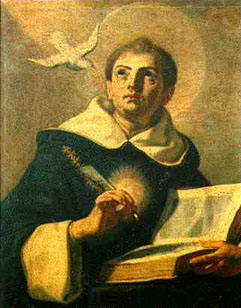
St. Thomas Aquinas, Doctor of the Catholic Church, pray for usSunday, September 28, 2008
Christ's Superabundant Cross
I'm currently reading through 1 Corinthians and the other day I read this verse:
St. Thomas Aquinas describes Christ's sacrifice on the cross as superabundant, it's like the famous evangelical worship song lyrics 'All of you, is more than enough for all of me, for every thirst and every need, you satisfy me with your love, and all I have in you, is more than enough'.
This morning I was thinking about the motto of Notre Dame University, crux spes unica 'the cross is our only hope'. It was then that I learned this is from an ancient latin hymn called "Vexilla Regis" dating back to 6th century Rome written by the Bishop of Poiters. (now aside from a debate about St. Helen and the True Cross, I want to include a portion of a translation of it)
Vexilla Regis
"Abroad the regal banners fly,
now shines the Cross's mystery:
upon it Life did death endure,
and yet by death did life procure.
Who, wounded with a direful spear,
did purposely to wash us clear
from stain of sin, pour out a flood
of precious water mixed with blood.
...
Blest Tree, whose happy branches bore
the wealth that did the world restore;
the beam that did that Body weigh
which raised up Hell's expected prey.
Hail Holy Cross, our only hope!
Now, in the mournful Passion time;
grant to the just increase of grace,
and every sinner's crimes efface.
Blest Trinity, salvation's spring
may every soul Thy praises sing;
to those Thou grantest conquest by
the Holy Cross, rewards supply. Amen."
This hymn reminded me of another hymn I heard the other day, which I am not trying to commit to memory. It was written by Annie Johnston Flynt who was extremely sick and frail for most of her life, and wrote this wonderful hymn in spite of everything she endured:
He Giveth More Grace
He giveth more grace as our burdens grow greater,
He sendeth more strength as our labors increase;
To added afflictions He addeth His mercy,
To multiplied trials He multiplies peace.
When we have exhausted our store of endurance,
When our strength has failed ere the day is half done,
When we reach the end of our hoarded resources
Our Father’s full giving is only begun.
Fear not that thy need shall exceed His provision,
Our God ever yearns His resources to share;
Lean hard on the arm everlasting, availing;
The Father both thee and thy load will upbear.
His love has no limits, His grace has no measure,
His power no boundary known unto men;
For out of His infinite riches in Jesus
He giveth, and giveth, and giveth again."
May you find hope in the glorius Cross of Our Lord, who provided more than enough grace for everyone to be washed of their sins in. May Grace lift us up, help us stand, and lead us on the path to Heaven. Praise to you Lord Jesus Christ
"For no one can lay any foundation other than the one that has been laid;
that foundation is Jesus Christ." - 1 Corinthians 3:11
St. Thomas Aquinas describes Christ's sacrifice on the cross as superabundant, it's like the famous evangelical worship song lyrics 'All of you, is more than enough for all of me, for every thirst and every need, you satisfy me with your love, and all I have in you, is more than enough'.
This morning I was thinking about the motto of Notre Dame University, crux spes unica 'the cross is our only hope'. It was then that I learned this is from an ancient latin hymn called "Vexilla Regis" dating back to 6th century Rome written by the Bishop of Poiters. (now aside from a debate about St. Helen and the True Cross, I want to include a portion of a translation of it)
Vexilla Regis
"Abroad the regal banners fly,
now shines the Cross's mystery:
upon it Life did death endure,
and yet by death did life procure.
Who, wounded with a direful spear,
did purposely to wash us clear
from stain of sin, pour out a flood
of precious water mixed with blood.
...
Blest Tree, whose happy branches bore
the wealth that did the world restore;
the beam that did that Body weigh
which raised up Hell's expected prey.
Hail Holy Cross, our only hope!
Now, in the mournful Passion time;
grant to the just increase of grace,
and every sinner's crimes efface.
Blest Trinity, salvation's spring
may every soul Thy praises sing;
to those Thou grantest conquest by
the Holy Cross, rewards supply. Amen."
This hymn reminded me of another hymn I heard the other day, which I am not trying to commit to memory. It was written by Annie Johnston Flynt who was extremely sick and frail for most of her life, and wrote this wonderful hymn in spite of everything she endured:
He Giveth More Grace
He giveth more grace as our burdens grow greater,
He sendeth more strength as our labors increase;
To added afflictions He addeth His mercy,
To multiplied trials He multiplies peace.
When we have exhausted our store of endurance,
When our strength has failed ere the day is half done,
When we reach the end of our hoarded resources
Our Father’s full giving is only begun.
Fear not that thy need shall exceed His provision,
Our God ever yearns His resources to share;
Lean hard on the arm everlasting, availing;
The Father both thee and thy load will upbear.
His love has no limits, His grace has no measure,
His power no boundary known unto men;
For out of His infinite riches in Jesus
He giveth, and giveth, and giveth again."
May you find hope in the glorius Cross of Our Lord, who provided more than enough grace for everyone to be washed of their sins in. May Grace lift us up, help us stand, and lead us on the path to Heaven. Praise to you Lord Jesus Christ
Tuesday, September 23, 2008
Luther and the Refuge of God
Hey folks, this is kind of a personal post, I'm really struggling in my own spiritual life and things are incredibly busy so I can't really post alot, but I read this the other day which I think is absolutely beautiful, even a Catholic - I think - could respect this particular passage, and I think Luther wrote many great works out of his love for God that both sides of the Tiber should revere. I also included a few other quotes that have helped me lately.
"Faith is a divine work in us, which transforms us, gives us a new birth out of God (John 1:13), slays the old Adam, makes us altogether different men in heart, affection, mind, and all powers, and brings with it the Holy Spirit. Oh, it is a living, energetic, active, mighty thing, this faith! It cannot but do good unceasingly. There is no question asked whether good works are to be done, but before the question is asked the works have been done, and there is a continuous doing of them. But any person not doing such works is without faith. He is groping in the dark, looking for faith and good works, and knows neither what faith is nor what good works are, although he indulges in a lot of twaddle and nonsense concerning faith and good works. Faith is a living, daring confidence in the grace of God, of such assurance that it would risk a thousand deaths. This confidence and knowledge of divine grace makes a person happy, bold, and full of gladness
in his relation to God and all creatures. The Holy Spirit is doing this in the believer. Hence it is that a person, without constraint, becomes willing and enthusiastic to do good to everybody, to serve everybody, to suffer all manner of afflictions, from love of God and to the praise of Him who has extended such grace to him. Accordingly, it is impossible to separate works from faith, just as impossible as it is to separate the power to burn and shine from fire. Accordingly, beware of your own false thoughts and of idle talkers, who pretend great wisdom for discerning faith and good works and yet are the greatest fools. Pray God that He may create faith in you; otherwise you will be without faith forever and aye, no matter what you may plan and do" - Martin Luther preface to Romans Commentary
"God is our refuge and strength, an ever-present help in trouble. Therefore we will not fear, though the earth give way...The LORD Almighty is with us; the God of Jacob is our fortress." - Psalm 46:1-2, 11
"Lord, you have been our refuge in all generations."- Psalm 90:1
"All that the Father giveth me shall come to me; and him that cometh to me I will in no wise cast out." - John 6:37 KJV
"A mighty fortress is our God, a bulwark never failing; our helper he amid the flood of mortal ills prevaling." - Martin Luther
"Fire. God of Abraham, God of Isaac, God of Jacob, not of the philosophers and the scholars...I will not forget thy Word" - Blaise Pascal after a near death experience
Thursday, September 18, 2008
Funny and Good Chesterton quotes I've encountered so far.
" The nineteenth-century neglect of tradition and mania for mere documents were altogether nonsensical. They amounted to saying that men always tell lies to children but men never make mistakes in books." (On Sola Scriptura)
"A young man will suddenly become a Catholic priest, or even a Catholic monk, because he has a spontaneous and even impatient personal enthusiasm for the doctrine of Virginity as it appeared to St. Catherine or St. Clare. But how many men become Baptist ministers because they have a personal horror of the idea of an innocent infant coming unconsciously to Christ? How many honest Presbyterian ministers in Scotland really want to go back to John Knox, as a Catholic mystic might want to go back to John of the Cross?"
"What is any man who has been in the real outer world, for instance, to make of the everlasting cry that Catholic traditions are condemned by the Bible? It indicates a jumble of topsy-turvy tests and tail-foremost arguments, of which I never could at any time see the sense. The ordinary sensible sceptic or pagan is standing in the street (in the supreme character of the man in the street) and he sees a procession go by of the priests of some strange cult, carrying their object of worship under a canopy, some of them wearing high head-dresses and carrying symbolical staffs, others carrying scrolls and sacred records, others carrying sacred images and lighted candles before them, others sacred relics in caskets or cases, and so on. I can understand the spectator saying, "This is all hocus-pocus"; I can even understand him, in moments of irritation, breaking up the procession, throwing down the images, tearing up the scrolls, dancing on the priests and anything else that might express that general view. I can understand his saying, "Your croziers are bosh, your candles are bosh, your statues and scrolls and relics and all the rest of it are bosh." But in what conceivable frame of mind does he rush in to select one particular scroll of the scriptures of this one particular group (a scroll which had always belonged to them and been a part of their hocus-pocus, if it was hocus-pocus); why in the world should the man in the street say that one particular scroll was not bosh, but was the one and only truth by which all the other things were to be condemned? Why should it not be as superstitious to worship the scrolls as the statues, of that one particular procession? Why should it not be as reasonable to preserve the statues as the scrolls, by the tenets of that particular creed? To say to the priests, "Your statues and scrolls are condemned by our common sense," is sensible. To say, "Your statues are condemned by your scrolls, and we are going to worship one part of your procession and wreck the rest," is not sensible from any standpoint, least of all that of the man in the street."
Tuesday, September 16, 2008
Jansenism Pt. 2 and Emphasis in Theology
Emphasis is important in theology. A church can believe in a doctrine but not emphasize it over a period of time. An example is 'sola gratia' - grace alone. Dr. R.C. Sproul is a very honest Reformed theologian and he says in his book "Faith Alone" that the Catholic Church has always fought to maintain that salvation is by the grace of God alone (though obviously not by faith alone, hence the Reformation). Louis Bouyer writes that if the Church focussed more on Grace Alone during the time of the Reformation, it is probable that the issues would have been settled. This is quite a claim of course, and easily debatable, but the general principle is that emphasis matters.
Jansenism is intriguing to me because I like it's emphasis, in only a few ways does it contradict Church teaching (possibly teaching limited atonement, and irresistible grace), but it places great emphasis on Election and the sovereign grace of God and faith in the work of Christ. It never denies that works justify or the nature of the communion or anything else like that (from the little of what I've read), but it does emphasize what I think at least is the 'best' of Protestantism and Catholicism.
Jansen himself wrote that if his doctrines were offensive to the Church that they should of course be disposed of and that he wished to be faithful to the Church, and I believe that is the point. The point is that emphasis needs to be reformed at times or shifted depending on the situation. Baptists for example believe in an eternally Hell for all believers which they will be conscious during, but I've never heard a sermon on it, because it's just alluded to briefly or like an 'unwritten law' that it exists. Thus if their churches start to doubt Hell, they should emphasize it.
Thus while I am not a Jansenist because it has been declared heretical, I definately agree with the emphasis and that the good parts of it's theology should be emphasized more. I don't know why people think Election is such a horrific doctrine, St. Paul, St. Augustine, St. Thomas Aquinas, and alot of others are in agreement that it is a beautiful thing. Active reprobation...is another story.
Subscribe to:
Posts (Atom)