For a Reformation History Class I have to read, compare and contrast the autobiographical conversions of Luther, Calvin, Menno, and Ignatius. I don't think our Prof picked the best sources, but nonetheless it's interesting reading them after my re-conversion (conversion to Catholicism, rather than conversion to Christ).
Menno Simons: growing up in a half-Mennonite background I have to say this guy stuck out like a sore thumb. He is so legalistic and self-righteous that it amazes me he could ever be said to have a share in the gospel of grace and faith alone (Maybe they should exclude the Anabaptists). He ends up describing how awesome he is as a biblical expositor and mentions that after conversing with Luther, Bucer, and Bullinger on infant baptism that they are all 'unbiblical' and foolish. He also notes that every Christian MUST be a pacifist, etc. Didn't like him at all. He ends his story by accusing the Catholics of being unbiblical because they allow repentant sinners to have communion, and that the Catholics should expel all "unrighteous persons" from their midst. ....seriously, does this guy even believe in imputed righteousness?!
Calvin: He can't seem to speak two sentences without mentioning the bondage of the will, everything he says about himself is in the passive voice. "I was forced by the divine will" I was "compelled against my will", the "violent hand of Heaven was upon me". Like we get it: you believe in predestination. He also uses the predestination thing to excuse himself from the guilt of executing heretics (he refers to them in the plural, so it makes me wonder if he only ever killed that unitarian doctor). The funniest part was when he made his exile from Geneva look like an accident. All in all, better than Simons, more humble for sure.
Ignatius Loyola: Here is where no one can call me biased. I think Ignatius was kind of dumb. For the sake of beauty he endures greatly painful surgery and then claims this pain was 'suffering for Christ'. He's basically converted by a Marian Ghost and a few Spanish hagiographies, and he has the arrogance to say that he wanted to out-saint St. Francis and St. Dominic (thus he would try to show his Jesuits better than the Franciscans and Dominicans). Kind of a hot-headed, theologically-ignorant, Spaniard. But he did find some good friends like St. Francis Xavier, and St. Robert Bellarmine, so I'll give him that, but from this reading he seemed to be my least favourite Jesuit.
Martin Luther: There's something about Luther, he's someone you just gotta love, or at least love to hate. While I do think it's ridiculous how he treated his prince like a bodyguard and glorified Church-State relations to the point of Caesaro-Papism just because it suited him, I still must say he is an awesome figure. He describes his holiness as a Catholic monk and his entire conversion seems to have nothing to do with "becoming a righteous Christian" but rather accepting Christ's righteousness and leaving it and simply being joyful about that. Even if he is a heretic, I think I'll always admire Luther in some ways (if nothing else, for giving me attacks on Reformed & Anabaptist Theology/Sacramentology)

Showing posts with label Anabaptistism. Show all posts
Showing posts with label Anabaptistism. Show all posts
Sunday, October 18, 2009

Tuesday, April 21, 2009
Circle of Death - Young Earth Creationism and Evolution
I was watching "Planet Earth" the other night with my mom, we'd just bought it, and it was fascinating how everything in the ecosystem eats each other. The eagles will eat the baby foxes and the foxes will be eating the eggs of the eagles, etc and at one point I saw a fox with 4 baby birds in it's mouth at once to bring back for its children to eat. I was thinking that it wasn't so much a circle of life as it was a circle of death. But that's how nature works.
I was at my parents Baptist church the other night and we were discussing evolution and I was saying that even though I don't hold to it, it has absolute support from the scientific community, and only those crazies on the outsides who are acting out of religious conviction - which is admirable but unscientific - disbelief in it. It works for 99% of life, and Creationists are out there finding the rapidly shrinking 1% of things they haven't explained (Biology never claims a comprehensive worldview anyway) and then try to show how they are irreducibly complex. But anyone who's actually read a book by Dawkins or an Evolutionary Biologist will tell you that all of those CAN be explained by natural selection, in fact he takes 10 examples from a Creationist book of 'irreducible complexity' and shows how they could have developed over time.
I really don't have a view on Creationism vs Evolution - as an Augustinian Christian I only hold 2 propositions about the whole event. 1. God created out of sheer superabundant love and joy for his own glory. and 2. Man willfully and knowingly sinned against him, and death remains the punishment and universal phenomenon of that sin. Obviously those are problematic with scientific evolution because man would have no official starting point, it would be just one chain of matter and categories would be arbitrary. So I couldn't strictly speaking believe in a world where everything is killing each other to survive, in essence, I couldn't believe in the world that we have right now. There had to be Shalom. The Hebrew reading of Genesis is that in the beginning God created the earth in peace/Shalom, man had peace with God, man and woman had peace, and man and creation had peace. It was all in Shalom. Natural selection doesn't work with this philosophical/theological view of nature.
But I'm not dumb enough to completely ignore the fossil record, obviously the whole point of evolution was to explain why we weren't digging up fossils of dogs and cats, etc, species we see walking around on the earth right now. So at some point there had to be dinosaurs, other weird scary things, and no humans on the earth. Which still synchs up with the general order of the universe. So I guess you could call me an Old Universe, Old Earth, Creationist. I have the same view as Chesterton who said he had no problem with evolution as a science/biology but as a philosophy it cannot co-exist with Christianity. But in my view, Science and the revelation to God's people are all a part of revelation and they should all come together, there shouldn't be a divergence. I was taught this in high school by the smartest Mennonite I know who taught us about Galileo, etc, and said "If science and religion come into conflict it is because one of them has made a mistake, it is either false science or false theology" and he cited the example of "The earth is firmly established it cannot be moved" from the Psalms and the rotation of the earth, and how that was a wrong hermeneutic we had, and that we've changed our theology accordingly. And things like the scientific acceptance of the Big Bang Theory (written by a Catholic Priest) gives me hope that Christianity and Science can play nicely together in the end.
But there will always be people like Dawkins, and people like the Inquisition, constantly fighting each other, and to paraphrase Donald Miller's Blue Like Jazz 'people have been fighting about it for so long that it no longer is a fight about what the truth is, but who can come up with cleverer arguments, so I stay away from it'. I obviously believe in God - Philosophically it's impossible to me to accept an atheistic universe - therefore I believe in creation, but I haven't studied biology enough to get in depth into debates, but as Chesterton says of the Unitarians and the Catholics I say of the Creationists and Evolutionists 'it's not as though we believed their doctrines which appeared strange so much as we simply believed that everyone should be given a fair chance even if they appeared strange' (paraphrased from Conversion and the Catholic Church). I just don't like the simplistic black and white dicotemies that place all anti-Christs with evolution , when many good Christian men are theistic evolutionists (like Alistair McGrath, and pretty much every Roman Catholic and Anglican theologian).
I'm at least glad that now I sit in a camp though (however weakly) of Old Earth Creationism, but even there I must laugh at myself because I think if we were ONLY studying the bible I would be a young earth creationist (John MacArthur's biblical studies on the topic are actually pretty strong that it isn't poetry - that is Genesis 1-3 - and never was considered poetry, and is literal, I just wish he'd take that approach to John 6 and 1 Cor 11 heh aka. Eucharist). If I was just going by science I'd be an evolutionist purely. So in Anglican style I'm taking the via media.
So at this church I told them basically: the problem is not over what science says - it clearly says evolution (no matter what the focus on the family video says) - the problem is over whether we should be teaching any science based on empiricism. Empiricism being essentially a non-Christian worldview and a philosophically untenable one as well. The whole venture of science is to look at ONLY the natural world, that's it's box it is closed within, obviously they will say nothing of the supernatural world, and that silence will be understood by most to mean non-existance. But if we as Christians believe that Naturalism (matter is the only real thing) is a flawed understanding of the world, we shouldn't be trying to get creationism taught in the classroom, we should be trying to get philosophy taught in the classroom, give every kid a summa theologica or Decartes Meditations, and they'll realize that the world is matter and spirit, that biology itself is flawed if it thinks it is a comprehensive worldview, etc.
But I was a Catholic so they drifted off when I included myself in the category of Christian, and just started glaring at me for not accepting their simple "Us and Them" mentality. It's amazing how Nietzschean the young earthers come off as they'd rather simply impose their will on others (including teaching children in schools) and banish any literature or idea that doesn't fit within their framework. Strangely enough it was Christendom that existed as the first self-critical worldview, welcomed debate and discussion, but apparently the sola scripturans are becoming more Muslim every day, religion of the book, fundamentalism, King James only/Arabic only authoritative. But again that's not me being anti-Protestant , that's Alistair McGrath's summation of modern fundamentalism in "Christianity's Dangerous Idea", he convincingly argues that the Anabaptist tradition of iconoclasm, etc, is almost identical to Islam. Confessional/Traditional Protestantism doesn't have such a problem, but I just have to laugh at the comment I read in history class the other day "The Saracens were quickly linked to the Protestants as they said only a Muslim or Calvin could so quickly dispose of a crucifix or desecrate a statue of the Virgin" History is funny - much funnier than I am. So ya. Ben Stein. Shut up...
Monday, March 16, 2009
A Hillariously Stupid Quote From Philip Schaff
"The development of the orthodox Mariology and Mariolatry originated as early as the second century in an allegorical interpretation of the history of the fall, and in the assumption of an antithetic relation of Eve and Mary, according to which the mother of Christ occupies the same position in the history of redemption as the wife of Adam in the history of sin and death [Rom 5:12 ff., 1 Cor 15:22] . . . Justin Martyr, Irenaeus, and Tertullian, are the first who present Mary as the counterpart of Eve, as a "mother of all living" in the higher, spiritual sense, and teach that she became through her obedience the mediate or instrumental cause of the blessings of redemption to the human race, as Eve by her disobedience was the fountain of sin and death.[Footnote: "Even St. Augustine carries this parallel between the first and second Eve as far as any of the fathers . . . "]" - Philip Schaff (History of the Christian Church, Vol. III: Nicene and Post-Nicene Christianity: A.D. 311-600)
Now Philip Schaff is one of the most reverenced Ecclesiastical Historians around (in the Protestant Tradition) but I have to say that I laughed out loud when reading this on Dave Armstrong's blog.
I mean if the early church (2nd century = REALLY early Church) fell into the 'heresy' of 'mariolatry' then just give up. Burn your bibles, throw out your crosses, sell your churches, because if God in all his sovereignty couldn't preserve the church before the new testament was even assembled, then he's the weakest god in history, or the strangest God. I could never tell a Mormon he wasn't a Christian if I agreed with Schaff, both agree (the mormon, and in this statement Schaff) to the ridiculous idea of 'the great apostasy'.
Chesterton writes on the early church that, it's strange how those who were motivated only by love for him (Jesus) would rush off and immediately do all those things he hated.
I know it's just one statement, and that Schaff is pretty solid, and I'm not trying to rub salt in the wound, but even the Anabaptists give the church till Constantine sanction, and let it not be said now or ever that the Lutherans stray further from the Christian history than the Anabaptists.
There you have it the "heresy" of Mariolatry taught by such degenerates as Justin Martyr, St. Irenaeus, Tertullian, St. Augustine and the other so-called "Early Church Fathers".
Wednesday, October 8, 2008
Roman Fire Upon These Profs!!!@#$@%@#%!!!
WARNING: This is an inflamatory piece of Catholic Rhetoric that was written in anger to all the Protestant Rhetoric I've had to read at university. Do not expect objectivity. Probably only Philip Wilson will enjoy this post.
It seems in life that one of two things is happening to me:
1) in an andrew-centric cosmos all effort is being thrown against him and thus last year he was almost overwhelmed by Atheist Profs, and this year by Mennonite Profs
or
2) Andrew is paranoid
I'm choosing 1.
This year at Brock it would seem that the heresy train has arrived before the atheist train and thus all of my Profs are what I like to call 'ignorant Protestants' - PLEASE NOTE - this category excludes Traditional Reformed, Lutheran, and Anglican Protestants who actually understand history and Catholicism for the most part. At least these people hold the 'catholic' faith (http://www.creeds.net/ancient/nicene.htm), unlike the Anabaptists.
But it would seem that Munster has been so overrun with garbage that they had to send some to Brock. I have 3 highly 'Evangelical' Mennonites, spreading the good news of 'Papist Evils', and the beauty of the late Dr. Martin Luther, clinically depressed schismatic, responsible for the greatest divisions in Church history, thus making him a Protestant saint.
Today I sat through a world religions lecture where Menno-Prof 1 - who was Liberal Theology Prof last year - waxed theological about how Catholics don't believe in salvation by grace alone (a strange claim as they invented the phrase "grace alone conquers sin" St. Augustine), and that they believe that salvation is through ALL 7 sacraments and the Pope. How on earth any individual could recieve all seven sacraments, I have no idea - it would certainly be tricky to be ordained a Priest with a vow of celibacy and be married to someone... I also apparently missed the part in the Catechism's treatment of salvation where wthe Pope directly saves people, but check for yourselves: http://www.scborromeo.org/ccc/p3s1c3a2.htm
We also had to sit through 3 U2 Songs to show us the 'beauty of protestant music'.
The only fact that he got right was when he said 'If you ever go to a Non-Denominational Church, it is just a Protestant Church disguised as something completely Christian and that alone'. Amen...
So what's wrong with Mennonites? you might ask: (I was hoping you would)
the following are a list of heresies prevalent in the Mennonite Tradition
-Credobaptism/Zwinglian view of baptism (see nicene creed - forgiveness of sins, not symbolic)
-Sola Fide (James 2:24)
-Sola Scriptura (1 Tim 3:15)
-Mariadelendaology (Mary hatred, delenda - is to destroy in latin)- my own latin invention for
the opposite of the heresy of Mariolatry (Mary worship). Menno Simmons actually taught
(arguably, as there is only one source) that Jesus was born through Mary's side (How Buddha
was born), and not in the natural way, and that Jesus wasn't actually any part of Mary, this is a
strange heretical mix of Buddhism with a special medieval protestant twist of hatred to women
(see John Knox) in that they are inherently dirty and unclean, and that no saviour could pass
through their _____. (Gen 3:15, 1 Jn 3:8)
-Priesthood of all believers/Congregationalism/idiots leading the church - I think one of the greatest heresies, that there should be no Church authorities. This is the reason why you have 50 year old car salesmen as elders of a church deciding on matters of theology when in some cases they don't even have a high school diploma, let alone any formal training in theology. If the Israelites were Mennonites they would've killed Moses, picked a new leader, killed him, ad infinitum, and Christ would never have come - barring he didn't pick the Irish or Egyptians or some other group to be his people.
-Antisophism : another word I just made up Sophia being greek for wisdom, mennonites being against it. When I was taking philosophy, my grandmother advised me not to 'seek after the vain knowledge that SOME would call wisdom' - I realized that once I did learn philosophy, I understood that all the Mennonite premises were logically faulty and thus realized why they hate intellectuals, because they have none themselves (barring John Howard Yoder).
Now that I just burned all of my bridges with Mennonite friends and family, I will take a time to catch my breath, watch the show, and heat my hands on their fire.
Sorry to everyone who read this and was offended/Sorry to everyone, i'm not belittling you, just your logical premises for belief.
ROMA VICTORIA!!!!!!!!
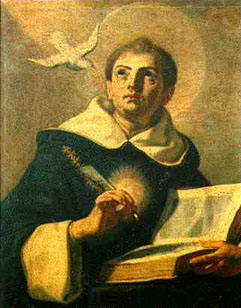
St. Thomas Aquinas, Doctor of the Catholic Church, pray for usThursday, September 18, 2008
Funny and Good Chesterton quotes I've encountered so far.
" The nineteenth-century neglect of tradition and mania for mere documents were altogether nonsensical. They amounted to saying that men always tell lies to children but men never make mistakes in books." (On Sola Scriptura)
"A young man will suddenly become a Catholic priest, or even a Catholic monk, because he has a spontaneous and even impatient personal enthusiasm for the doctrine of Virginity as it appeared to St. Catherine or St. Clare. But how many men become Baptist ministers because they have a personal horror of the idea of an innocent infant coming unconsciously to Christ? How many honest Presbyterian ministers in Scotland really want to go back to John Knox, as a Catholic mystic might want to go back to John of the Cross?"
"What is any man who has been in the real outer world, for instance, to make of the everlasting cry that Catholic traditions are condemned by the Bible? It indicates a jumble of topsy-turvy tests and tail-foremost arguments, of which I never could at any time see the sense. The ordinary sensible sceptic or pagan is standing in the street (in the supreme character of the man in the street) and he sees a procession go by of the priests of some strange cult, carrying their object of worship under a canopy, some of them wearing high head-dresses and carrying symbolical staffs, others carrying scrolls and sacred records, others carrying sacred images and lighted candles before them, others sacred relics in caskets or cases, and so on. I can understand the spectator saying, "This is all hocus-pocus"; I can even understand him, in moments of irritation, breaking up the procession, throwing down the images, tearing up the scrolls, dancing on the priests and anything else that might express that general view. I can understand his saying, "Your croziers are bosh, your candles are bosh, your statues and scrolls and relics and all the rest of it are bosh." But in what conceivable frame of mind does he rush in to select one particular scroll of the scriptures of this one particular group (a scroll which had always belonged to them and been a part of their hocus-pocus, if it was hocus-pocus); why in the world should the man in the street say that one particular scroll was not bosh, but was the one and only truth by which all the other things were to be condemned? Why should it not be as superstitious to worship the scrolls as the statues, of that one particular procession? Why should it not be as reasonable to preserve the statues as the scrolls, by the tenets of that particular creed? To say to the priests, "Your statues and scrolls are condemned by our common sense," is sensible. To say, "Your statues are condemned by your scrolls, and we are going to worship one part of your procession and wreck the rest," is not sensible from any standpoint, least of all that of the man in the street."
Friday, April 4, 2008
Discipline and Life Change as a result of what we believe
"All living theology grows out of personal experience" - Howard H. Brinton (Friends Theologian)
I think this is a very important idea, that whatever our philosophy of life be, or our theology is, that it should be intrinsically tied to our living. Religion was once defined by a teacher of mine as 'how to live right', and the latin 'religare' means a 'relationship with God'. Both of these definitions work together in my opinion.
Some might say that my theology changes my life as it's generally all I talk about, and the fact that I am hated at brock for it. However I must say that I have so much to live out in my faith. I thirst for discipline, and the ability to act upon what I know is right. I know Walmart uses child labour and that Shane Claiborne is right about most things, but at the same time, I don't seem to believe what I preach enough to actually act on it and drive somewhere else. This isn't just about theology either, take the environment. My brother works as a Forest Ranger guy and his wife is in the Ministry of Natural Resources job circuit as well, I've read alot of theology about ecology and how we should treat the earth better. I mean who thinks we should ruin the earth? no one. So I support the Green Party in debates lots of times, and defend extra costs spent to protect nature, but what do I do? Drive an SUV by myself with Premium Gas, and then vote conservative because they lower our taxes. What an awful contradiction. There are plenty of other sins I could go into but I'll keep this G-rated.
I am fascinated as I study the Anabaptists, the Mennonite Brethren, the Quakers and the Low Church denominations alot. After studying the high church Anglican/Catholic/Orthodox theology, it is like a breath of fresh air - or maybe just air that I am more comfortable with. I am amazed at them because they act so strongly on what they believe. They don't go to war, they live completely simple lives, away from society, in a Christian family, and abstain from pretty much everything. Many of them even in the 17th centuries like the Quakers refused baptism because they believed wholly in Christ and that he didn't need 'a sprinkling of cold water' -as one Quaker said- to save them. Now this isn't shocking to most, but just look at this debate between Voltaire (Catholic/Deist) and a Quaker: http://www2.gol.com/users/quakers/voltaire_and_the_quakers.htm
It was believed (and still is even by some protestant denominations) that for someone not to be baptized was for them not to be a Christian. Voltaire gets horrified about the fact that this holy man who loves the Lord hasn't been baptized. The Quaker defends himself and pretty much pwns Voltaire in the end using scripture.
Where this ties into the topic again, is the fact that they believed something strongly about God, that is not 'served by human hands' as Paul says in Acts 17, and even though many said they were in fear of Hell, they stuck firm and trusted God. I desire in my own life the strength to live that way. To be simple, and to know what is right and do it. To live right in every aspect, healthwise, schoolwise, jobwise, etc.
I've currently reordered my own values and tried a bit and put alot more emphasis on Christ, and not worry so much about my own accomplishments and success as just being satisfied in his goodness. I know that sounds stupidly trite and 'spiritual' but actually I think that all 3 of you reading this might disagree with this choice, and maybe it is wrong, I don't know (just trusting my inner light as the Friends say). But if I'm worried about school or stressed out from a long day and I have homework or something, I just sit down and pray or relax or read my bible instead. So I might do worse in school, but I am much more at peace, and I am constantly remembering that my entire life is in God's hands and he will lead me wherever I go, and that I should be still and know that he is God, instead of trying to prove myself and earn my own self-worth from my meager accomplishments. Maybe I'm just 'Christianizing' laziness, but I don't know, and maybe I'm totally wrong, but right now it is the path I am taking, and in this moment I look to my brothers and sisters the Anabaptists and remember that my religion is about living right, and being a Friend of God.
Wednesday, April 2, 2008
The Anabaptists: From the Radical Reformation to Radically Dogmatic
I was thinking about the History of the Anabaptists today. The Church I was raised in and the school I was taught in were both Mennonite/Anabaptist. When I read history about them it is hillarious for me to categorize them as 'The Radical Reformation' - Radical? ... a church that excommunicates someone for dancing seems a little old fashioned to me, but such is the historical shift. I think it's funny to read about the first Anabaptists and how they set up this polygamous theocracy in Munster, believing that once they had enough babies and reached 144 000 people, they would be raptured and the Kingdom of God would be at hand. I know people who have been kicked out of Anabaptist churches for getting pregnant, and I can barely imagine one where people were constantly copulating in hopes of bringing about God's will.
Menno Simons I guess was quite different from those at Munster, so maybe that ties in a bit. As I read his writing I find nothing that shocking; in fact about 70% of his writing is just direct quotes from Scripture and the other 30% is about how Catholics are wrong about everything... so maybe there is a bit of continuity between the Mennonites then and now lol. The only shocking thing I found was that he quotes the Apocrypha, right next to scripture and makes no distinction. I think that fact would scare a few of the grannies at the local MB church.
As cynical as I can be about the Mennonites, they do have a great history. I will always remember the stories my grandmother handed down to me about how the Ukranian Orthodox and the Mennonites used to actually befriend each other at the time of the Bolshevik Revolution and how they escaped to Canada with money sown in their clothes and had miracles occur where they narrowly escaped guards and jumped off trains and hid in fields, all to preserve their faith. Maybe that's why my grandma was so pissed when I looked at Catholicism, it's like a slap in the face to all of my heritage. It's wild how movements change though. Nowadays the Mennonites are strangely dogmatic in their anti-dogmatism. So they claim to have no creed, but if someone brings up Just War theory they call them heretics, or if someone mentions infant baptism, they are on the side of the Anti-Christ. Maybe when you are persecuted by everyone (like they were in the Reformation), you choose what things you'll die for, and in essence become dogmatic about those things. It's probably hard to die for the freedom to choose to believe whatever you want. It's a bit airy.
I did find it funny though that one Reformation program said that the Anabaptists promoted 3 things which were intolerable to 16th century culture:
1. Freedom to choose your own religion, 2. Not drinking alcohol, 3. Not beating your wife. lol good ol' Anabaptists
Subscribe to:
Posts (Atom)