Showing posts with label Pope St. Gregory the Great. Show all posts

Tuesday, April 10, 2012

Sola Scriptura ; Solo Traditio ; Sola Papa - Three Bad Answers to Some Good Questions

"so I send this commentary to your reverence, not because I think it due and worthy, but because I remember you asked for it and I promised to send it. Whatever your holiness finds half-baked or crude in its pages, please forgive it all the more quickly" - Pope St. Gregory the Great , teaching infallibly on matters of faith and morals ;)

The more of the Church Fathers I read, the less I feel bound to their authority. They seem adamant on telling us NOT to trust them on their own basis. The notion that they had some kind of hidden wisdom apart from Scripture, or were a part of the Word of God, as Papa Benny 16 likes to say, would probably seem blasphemous to them. Certainly the doctrine of justification by faith alone would seem blasphemous to a writer like St. Gregory (though not Chrysostom), but what seems always clear to me is how off course the Western Tradition went after St. Augustine. The Orthodox (I think at the moment) are quite accurate in their assertions that the Latin Tradition of theology is very different from the patristic consensus. If the Protestant Reformation went off course, then it had long precedence from the See of Rome, which changed many things, to the point that the generally acknowledged first tradition of the Church (The Sign of the Cross) was changed by Papal decree by Pope Innocent III. St. Augustine of Canterbury, St. Benedict, St. Patrick, all did it the 'wrong' Orthodox way.

This is where you'd normally expect to see me talking about visiting my local Antiochan parish, but no, I don't find the Orthodox way convincing to the point of necessary conversion. I think in a contest of Tradition they'd beat the Romans, but the discrepancies between the two seem to only further my Latin/Catholic notions that Tradition -while important- should not have the last say in matters of faith and morals.

After all, if in the Sacred Tradition of the Church, the Pope tells us not to trust his dogmatic writing if it is in error, then what are we to use as the standard? Answering that question is fraught with problems, however I've chosen Sacred Scripture, and used a hearty textual realism to defend myself from the textual relativist claims of Rome. Everyone must make a choice though, and thus everyone must become a heretic (one who chooses). Though the heresies of today are not like those of Old. To be a Baptist is heretical, true enough, but even Baptists can sign the formula of Chalcedon, and assent to the Council of Ephesus (451) which in a sense makes them more 'Traditional', 'Catholic', and 'Orthodox' than the Coptic Church and all its bishops. It seems to be a realm where 'you pay your money and you take your chance' as an old pastor used to say.

You could 'pan' any of the Fathers for 'Confessional gold' and come up with some argument in your favour. So perhaps the Orthodox would use the initial quotation to attack Papal Supremacy and show the equality of bishops. Roman Catholics might look use this passage: "[Job's friends] speak to Job as if on the Lord's behalf, but they are not approved by the Lord; for all heretics struggle to defend God but really offend him." to show how Orthodox and Protestant heretics/Christians are in wanton disobedience to the papacy. Finally, Protestants who look for a self-verifying canon of Scripture against Catholic-Orthodox apologetics could read: "The authority of this book is made clear from the unshakeable sacred page itself." and shout Aha! Our Bible has been vindicated against the traditions of men.

To end things very Lutheran-ly, I'd say all of these modes are theologies of glory. There are many mysterious things which we do not perceive while we 'see through a glass darkly', but the fundamental character and substance of God remains apparent to Christians. Faith, Hope, and Charity are found in every communion, and in these, as in Christ we are to abide. For my part, I look at myself knowing that like Job's sons 'perhaps I have sinned in my heart'. I know I am a sinner, but I trust in the fact that Christ has christened, confirmed, confessed, and communed me Himself. That all my sins are his and all his righteousness is mine. I glory not in my own theological and historical polemics but in my Saviour and his cross.

I found most illuminating, a passage of St. Gregory's on the typology of Jobs daughters as weaker Christians (which is a horribly misogynistic spiritual reading perhaps, but still useful).

"And three daughters were born to him. (1.2)
"What shall we take the daughters for, if not the flock of less-gifted faithful? Even if they do not stay the course for the perfection of good works by strength and virtue, they cling tenaciously to the faith they know in the trinity." XIV. 20


May the Holy Spirit, the only author of faith, who proceeds from the Father, through the Son, make us all tenaciously cling to whatever faith has been graciously given us, and trust in the Holy Trinity in every trouble.

Thursday, January 5, 2012

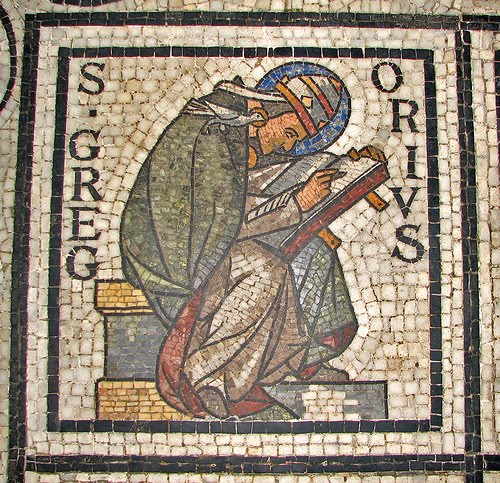
That Old Liturgical Latitudinarian, Pope St. Gregory the Great

"You know, my brother, the custom of the Roman church in which you remember you were trained. But if you have found anything in either the Roman or the Gallican or any other church which may be more acceptable to Almighty God, I am willing that you carefully make choice of the same and diligently teach the English church, which is as yet new in the faith, whatever you can gather from the several churches. For things are not to be loved for the sake of places but places for the sake of good things. Select, therefore, from every church the things that are devout religious and upright, and when you have, as it were, combined them into one body, let the minds of the English be trained therein." (to St. Augustine of Canterbury) in the Venerable Bede's Ecclesiastical History of the British Isles

Wednesday, April 28, 2010

Interesting Point by Gregory the Great


I started Pope St. Gregory the Great's commentary on Job this morning and noticed something most biblical scholars should take note of these days.

St. Greg is going through the authorship debates of Job and makes this comment after summing up all the different possibilities:

"But who was the writer, it is very superfluous to enquire; since at any rate the Holy Spirit is confidently believed to have been the Author. He then Himself wrote them, Who dictated the things that should be written. He did Himself write them Who both was present as the Inspirer in that Saint's work, and by the mouth of the writer has consigned to us his acts as patterns for our imitation." (http://www.lectionarycentral.com/GregoryMoralia/Preface.html)

I was also amazed at his depth of insight into the debates on who wrote Job, the fathers were much smarter than some people give them credit for. This summer, I want to pick a father and just try to read everything he wrote (perhaps St. Gregory as I've read his letters to St. Anselm in the Ven. Bede's English history already).

He had some other great quotes I found as well:

"Holy Scripture is a stream in which the elephant may swim and the lamb may wade."

"Learn the heart of God from the Word of God"

"The Bible is a letter from Almighty God to His creatures."

Which Protestants would jump on to say AHA! he was a proto-protestant...untill you read his other work on purgatory / soteriology.

A very great man though to be sure. Jaroslav Pelikan seemed to paint him as a mindless plagiarist/copyist of St. Augustine, but I'm seeing he goes deeper than that.

Wednesday, February 4, 2009

Gregory the Great on Job


I've started re-reading the book of Job and was looking for a patristic commentary on it and I found out that Pope St. Gregory the Great, who according to Calvin was 'the last good pope', wrote a commentary on Job. I couldn't find it on Newadvent or any other site, but I finally found it here: http://www.documentacatholicaomnia.eu/01p/0590-0604,_SS_Gregorius_I_Magnus,_Moralia_in_Job,_EN.doc and it's like 177 pages. Right now I'm about 500 pages behind on reading for school, but I'd like to try and read it alongside Job. It could be fun.
I like the introduction to it already, it's really honest about his life and reminds me a bit of St. Augustine's Confessions:
"I had long fended off the grace that would convert me, and how even after I was touched by the longing for heaven I chose to stay hidden beneath worldly garb. I had already been shown the love of eternity that should fill my desires, but the chains of long-bred habit kept me from altering my outer way of life. While my heart forced me to go on serving this world (at least to all appearances) many worldly pressures began to arise that threatened to bind me to this world not in appearance only but (what is more burdensome) in mind as well. Finally I fled all that in my anxiety and sought the cloister's harbor. I thought, in vain as it turned out, that I had finally abandoned the things of the world and come to shore naked from the shipwreck that is this life. But often a storm arises and the waves blast a carelessly moored ship away from even the safest port. Thus suddenly I found myself, under cover of Holy Orders, back on the sea of secular affairs."
It's this kind of description which reminds me of how the monastic movement started, out of a sincere devotion to God. Ultimately anyone familiar with late medieval history will realize the dream eventually turned into a nightmare and in many places monasteries were quite corrupt. In any case, this is quite a story I hope I eventually get to read.