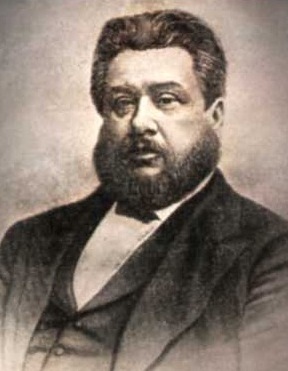
 “. . .If you take away the grace of God from the gospel you have extracted from it its very life-blood, and there is nothing left worth preaching, worth believing, or worth contending for. Grace is the soul of the gospel: without it the gospel is dead. Grace is the music of the gospel: without it the gospel is silent as to all comfort. I endeavoured also to set forth the doctrine of grace in brief terms, teaching that God deals with sinful men upon the footing of pure mercy: finding them guilty and condemned, he gives free pardons, altogether irrespective of past character, or of any good works which may be foreseen. Moved only by pity he devises a plan for their rescue from sin and its consequences—a plan in which grace is the leading feature. Out of free favour he has provided, in the death of his dear Son, an atonement by means of which his mercy can be justly bestowed. He accepts all those who place their trust in this atonement, selecting faith as the way of salvation, that it may be all of grace. In this he acts, from a motive found within himself, and not because of any reason found in the sinner’s conduct, past, present, or future. I tried to show that this grace of God flows towards the sinner from of old, and begins its operations upon him when there is nothing good in him: it works in him that which is good and acceptable, and continues so to work in him till the deed of grace is complete, and the believer is received up into the glory for which he is made meet. Grace commences to save, and it perseveres till all is done. From first to last, from the “A” to the “Z” of the heavenly alphabet, everything in salvation is of grace, and grace alone; all is of free favour, nothing of merit.” – Charles Spurgeon

Monday, September 8, 2008
Sola Gratia - Charles Spurgeon
“. . .If you take away the grace of God from the gospel you have extracted from it its very life-blood, and there is nothing left worth preaching, worth believing, or worth contending for. Grace is the soul of the gospel: without it the gospel is dead. Grace is the music of the gospel: without it the gospel is silent as to all comfort. I endeavoured also to set forth the doctrine of grace in brief terms, teaching that God deals with sinful men upon the footing of pure mercy: finding them guilty and condemned, he gives free pardons, altogether irrespective of past character, or of any good works which may be foreseen. Moved only by pity he devises a plan for their rescue from sin and its consequences—a plan in which grace is the leading feature. Out of free favour he has provided, in the death of his dear Son, an atonement by means of which his mercy can be justly bestowed. He accepts all those who place their trust in this atonement, selecting faith as the way of salvation, that it may be all of grace. In this he acts, from a motive found within himself, and not because of any reason found in the sinner’s conduct, past, present, or future. I tried to show that this grace of God flows towards the sinner from of old, and begins its operations upon him when there is nothing good in him: it works in him that which is good and acceptable, and continues so to work in him till the deed of grace is complete, and the believer is received up into the glory for which he is made meet. Grace commences to save, and it perseveres till all is done. From first to last, from the “A” to the “Z” of the heavenly alphabet, everything in salvation is of grace, and grace alone; all is of free favour, nothing of merit.” – Charles Spurgeon

Sunday, September 7, 2008
Honest To God - Part 1 - The Gospel
The very controversial book by an Anglican bishop titled 'Honest to God' was the work of famous (or rather infamous) liberal theology and a general attack at Traditional Christian Theology. I'm not going liberal (though I do like the Quakers), but I decided that instead of constantly publishing polemics, this series is going to go in favor of a more personal approach to theology. Rather than entrenching myself within Catholicism or Protestantism, I'll just state my beliefs about things from my limited reading of Tradition/Church Fathers, Scripture, Logic, and Personal Experience (Wesleyan quadrilateral is my favourite approach to Christianity).
I'm hoping to cover 3 topics:
1. The Gospel
2. The Holy Spirit
3. The Sacraments
*note: Today I signed up for RCIA at the Catholic Cathedral in town, so please don't guilt trip me about not being Catholic enough, I'm following through with it. Thus my Catholic Ecclesiology has beat my Protestant Soteriology, and Church Tradition/History has beat Scripture.
Man:
"Man is nothing but a subject so naturally full of error that it can only be eradicated through grace." -Blaise Pascal
I've heard alot of arguments on the subject, I think in the end that St. Augustine, and John Calvin are correct in their assessment. I believe that the unregenerate man can neither do good, nor even think it, as the Bondage and Liberation of the Will says. I think mankind only has the free choice to choose between sin and sin.
Christ:
I believe that at the culmination of the ages, Christ came as the God-Man to reconcile the world to God and redeem those the father had given him. I believe as Scripture says that Christ died for all, and his message should be addressed to all people, yet at the same time his sacrifice was only efficient for some. I've been influenced alot by reading "Spurgeon v. Hyper-Calvinism" by Iain Murray, in understanding the balance and historic Calvinism.
I don't know about the saints or mother teresa or others, but in my own personal opinion and in contradiction to the teaching of my church, I believe that I have nothing to offer God, and that as a begger I come to the Lord, unconditionally elected, and saved solely by his grace alone. Even my repentence is done in selfishness and fear of Hell, but trusting Christ, I believe he will lead me to Heaven.
I read this verse today which comforted me greatly "I am the good shepherd. I know my own and my own know me" -John 10:14
Calvinism:
For those of you who know theology, you'll realize I basically have a completely Reformed/Calvinistic view of Salvation (Soteriology), you are right in saying that. I just don't know how to explain the Gospel in Catholic terms, the Reformed/Augustinian way is the only way I understand.
Whenever I explain the gospel in Catholicism, I can usually convince people - it's almost the same gospel as Methodism/Wesleyan/Arminianism - but for me on a completely individual and personal level the Gospel of the Church Fathers and of the Catholic Church is terrible news. It's a requirement I could never live up to (perfection), and it makes Christ more of a legalist than a lover. The Early Church (2nd century) even taught that if you sinned after baptism you could not be forgiven, as J.N.D. Kelly points out. But I think I'll be a sinner my whole life. Simul Iust et Pecatur or something like that right?
I hope against hope that Christ loves me unconditionally and not based on my own merits or acheivements. These are the things that God has revealed to me personally in my life, as I said, I cannot provide logically indefensible proof for why I believe them, and I am branded a heretic for believing them in the Communion of Rome, please don't remind me, I KNOW.
Conclusion:
I am still becoming a Roman Catholic, but this kind of message or Gospel -whether or not it is 'another gospel' (Gal 1:8) - will always bring tears to my eyes. If God took me back in time and gave me one request, one thing I could make to be true, it would be salvation by grace alone, through faith alone, because of Christ alone. But as I said, I don't 'really' believe it, and see tons of problems with it, etc. But again this is just at a personal level.
I really wish I was " justified by his grace as a gift, through the redemption that is in Christ Jesus, whom God put forward as a sacrifice of atonement by his blood, effective through faith" - Romans 3:24-25
Saturday, September 6, 2008
Free Will & C.S. Lewis
I know of no argument for free-will except the bible and even there it is difficult to prove it. I daresay that Luther won the argument against Erasmus, and I'd held the Reformed view of Free Will, I think Edwards explains it well. I don't know how it can be reckoned to Catholicism or even Arminianism. However aside from this un-endable debate I'd like to address one reason why I was always uneasy about free-will. C.S. Lewis illustrates it here well, and that reason is fear. Even though Reformed theology always pins the blame on the person even if they had no choice, I always fell on the more Modern Philosophical ideas I'd been taught at school, that if you had no control then you had no blame or at least it would be taken into consideration. All I'd have to do to be justified in Protestantism is admit that I am scum and Christ is the opposite, etc. To actually have to choose Jesus every day over myself is really hard, and it shows my level of real commitment. C.S. Lewis wrote this on the subject (which I stole from Criffton's blog):
“Every time you make a choice, you are turning the central part of you, the part of you that chooses, into something a little different from what it was before. And, taking your life as a whole, with all your innumerable choices, all your life long you are slowly turning this central thing either into a Heaven creature or into a hellish creature -- either into a creature that is in harmony with God, and with other creatures, and with itself, or else into one that is in a state of war and hatred with God, and with its fellow creatures and with itself. To be the one kind of creature is Heaven: that is, it is joy, and peace, and knowledge, and power. To be the other means madness, horror, idiocy, rage, impotence, and eternal loneliness. Each of us at each moment is progressing to the one state or the other." - C.S. Lewis
how's that for works-righteousness/works based salvation.
'...and the crowds of angry reformers dropped their rocks, as they looked upon the offender, who incidentally, had written some of their favourite books... to depart in disappointment of the now unmasked Author...oh how the mighty have fallen'.
Friday, September 5, 2008
Shakespeare and Purgatory in Hamlet
“My hour is almost come,
When I to sulphurous and tormenting flames
Must render up myself.
…
I am thy father's spirit,
Doom'd for a certain term to walk the night,
And for the day confined to fast in fires,
Till the foul crimes done in my days of nature
Are burnt and purged away. But that I am forbid
To tell the secrets of my prison-house,
I could a tale unfold whose lightest word
Would harrow up thy soul, freeze thy young blood,
Make thy two eyes, like stars, start from their spheres,
Thy knotted and combined locks to part
And each particular hair to stand on end,
Like quills upon the fretful porpentine:
But this eternal blazon must not be
To ears of flesh and blood. List, list, O, list!
If thou didst ever thy dear father love—
…
Thus was I, sleeping, by a brother's hand
Of life, of crown, of queen, at once dispatch'd:
Cut off even in the blossoms of my sin,
Unhousel'd, disappointed, unanel'd,
No reckoning made, but sent to my account
With all my imperfections on my head:
O, horrible! O, horrible! most horrible!” - King Hamlet's Ghost
I heard this passage the other day and thought it was amazing how I didn't at all understand this part in high school - that is, before I was introduced to the dogma of Purgatory. It is abundantly clear that this is what the Ghost is referring to. It is unmistakeable. For King Hamlet is resigned to dwell in this purging fire for a certain time because he had died in sin, and there was 'no reckoning made' - he was not absolved in the sacrament of Penance and had no last rites either. Thus he died with all his venial sins left on his soul.
In Protestantism I was always taught that Ghosts were just demons etc, and many Catholics believe that, but I found out from reading Kreeft that there are alot of theologies that are build up - mostly from Philosophy rather than Scripture about ghosts and animals in Heaven, etc. I thought this was an interesting and spooky quote and it had to do with Theology, so I put it up.
Monday, September 1, 2008
Pope as Anti-Christ or the Church as God's Instrument?
"Surely anybody's commonsense would tell him that enthusiasts who only met through their common enthusiasm for a leader whom they loved, would not instantly rush away to establish everything that he hated." - G.K. Chesterton on the History of the Catholic Church (critique of Evangelical theory of the universal apostasy of the Church)
"Be not deceived, my brethren: If anyone follows a maker of schism [i.e., is a schismatic], he does not inherit the kingdom of God; if anyone walks in strange doctrine [i.e., is a heretic], he has no part in the passion [of Christ]. Take care, then, to use one Eucharist, so that whatever you do, you do according to God: For there is one flesh of our Lord Jesus Christ, and one cup in the union of his blood; one altar, as there is one bishop, with the presbytery and my fellow servants, the deacons" - St. Ignatius of Antioch (Letter to the Philadelphians 3:3–4:1 [A.D. 110]).
"The authority of these [ecumenical] councils in the decision of all points of controversy was supreme and final. Their doctrinal decisions were early invested with infallibility; the promises of the Lord respecting the indestructibleness of his church, his own perpetual presence with the ministry, and the guidance of the Spirit of truth, being applied in the full sense to those councils, as representing the whole church. After the example of the apostolic council, the usual formula for a decree was: Visum est Sprirtui Sancto et nobis. Constantine the Great, in a circular letter to the churches, styles the decrees of the Nicene council a divine command; a phrase, however, in reference to which the abuse of the word divine, in the language of the Byzantine despots, must not be forgotten. Athanasius says, with reference to the doctrine of the divinity of Christ: "What God has spoken by the council of Nice, abides forever." The council of Chalcedon pronounced the decrees of the Nicene fathers unalterable statutes, since God himself had spoken through them. The council of Ephesus, in the sentence of deposition against Nestorius, uses the formula: "The Lord Jesus Christ, whom he has blasphemed, determines through this most holy council." Pope Leo speaks of an "irretractabilis consensus" of the council of Chalcedon upon the doctrine of the person of Christ. Pope Gregory the Great even placed the first four councils, which refuted and destroyed respectively the heresies and impieties of Arius, Macedonius, Nestorius, and Eutyches, on a level with the four canonical Gospels. In like manner Justinian puts the dogmas of the first four councils on the same footing with the Holy Scriptures, and their canons by the side of laws of the realm." - Philip Schaff endorsing conciliar infallibility (History of the Christian Church, Vol. III: Nicene and Post-Nicene Christianity: A.D. 311-600, Grand Rapids, MI: Eerdmans Publishing Company, 1974, from the revised fifth edition of 1910, 340-342
"With a false bishop appointed for themselves by heretics, they dare even to set sail and carry letters from schismatics and blasphemers to the chair of Peter and to the principal Church [at Rome], in which sacerdotal unity has its source; nor did they take thought that these are Romans, whose faith was praised by the preaching Apostle, and among whom it is not possible for perfidy [error] to have entrance." (Cyprian, Letter 59 (55), 14 to Cornelius of Rome, c. AD 252)
Many Protestants accuse the Roman Catholic (and every other rite of the Catholic Church) Church of giving the Pope 'too much power' and as "Anti-Christ" for he usurps the position of Christ. However what if Christ GAVE St. Peter this role. What if Christ said "On this rock will I build my Church", what if Christ said "Peter feed my Lambs", what if Christ gave him authority to forgive sins (Jn 20:23), to lead and teach the Church (acts 2)... He did say and do those things. So to put up a dichotemy between Christ and the Roman Catholic Church is impossible, he promised both of them would work together.
The Church Fathers taught and died for the Church, the ONE Church, the Catholic faith. How on earth can I desert that just because John Calvin came along and thought the Church read Romans wrong? What kind of logic is that?
Let me end with this:
"In the Church God has placed apostles, prophets, teachers, and every other working of the Spirit, of whom none of those are sharers who do not conform to the Church, but who defraud themselves of life by an evil mind and even worse way of acting. Where the Church is, there is the Spirit of God; where the Spirit of God is, there is the Church and all grace" -St. Irenaeus(Against Heresies 3:24:1 [A.D. 189]).
So is the Catholic Church usurping Christ's role to distribute all grace? or are Calvinist's denying Christ's claim to establish a Church which distributes all grace? The Fathers side with Catholicism.
Why I Cannot Be A Protestant Christian (Part 3): Petrine Supremacy
I was going to write a lengthly post on Petrine Supremacy, but I found online this short essay on the subject by Pope Benedict XVI, St. Peter's current successor, and he does a much better job than I could. Here it is:
"In recounting Jesus' first meeting with Simon, the brother of Andrew, John the Evangelist records a unique event: Jesus "looked at him and said, 'So you are Simon the son of John? You shall be called Cephas (which means Peter)'" (Jn 1:42).
It was not Jesus' practice to change his disciples' names: apart from the nickname "sons of thunder", which in specific circumstances he attributed to the sons of Zebedee (cf. Mk 3:17) and never used again. He never gave any of his disciples a new name.
Yet, he gave one to Simon, calling him "Cephas". This name was later translated into Greek as Petros and into Latin as Petrus. And it was translated precisely because it was not only a name; it was a "mandate" that Petrus received in that way from the Lord. The new name Petrus was to recur frequently in the Gospels and ended by replacing "Simon", his original name.
Peter's special prominence
This fact acquires special importance if one bears in mind that in the Old Testament, a change of name usually preceded the entrustment of a mission (cf. Gn 17:5; 32:28ff., etc.).
Indeed, many signs indicate Christ's desire to give Peter special prominence within the Apostolic College: in Capernaum the Teacher enters Peter's house (cf. Mk 1:29): when the crowd becomes pressed on the shore of Lake Genesaret, seeing two boats moored there, Jesus chooses Simon's (cf. Lk 5:3); when, on certain occasions, Jesus takes only three disciples with him, Peter is always recorded as the first of the group: as in the raising of Jairus' daughter (cf. Mk 5:37; Lk 8:51), in the Transfiguration (cf. Mk 9:2; Mt 17:1: Lk 9:28) and during the agony in the Garden or Gethsemane (cf. Mk 14:33: Mt 26:37). And again: the Temple tax collectors address Peter and the Teacher pays only for himself and Peter (cf. Mt 17:24-27); it is Peter's feet that he washes first at the Last Supper (cf. Jn 13:6), and for Peter alone he prays that his faith will not fail so that he will be able to strengthen the other disciples in faith (cf. Lk 22:34-31).
Moreover, Peter himself was aware of his special position: he often also spoke on behalf of the others, asking for the explanation of a difficult parable (cf. Mt 15:15), the exact meaning of a precept (cf. Mt 18:21) or the formal promise of a reward (cf. Mt 19:27).
It is Peter in particular who resolves certain embarrassing situations by intervening on behalf of all. Thus, when Jesus, saddened by the misunderstanding of the crowd after the Bread of Life discourse, asks: "Will you also go away?", Peter's answer is peremptory in tone: "Lord, to whom shall we go? You have the words of eternal life" (cf. Jn 6:67-69).
Equally decisive is the profession of faith which, again on behalf of the Twelve, he makes near Caesarea Philippi. To Jesus' question: "But who do you say that I am?" Peter answers: "You are the Christ, the Son of the living God" (Mt 16:15.1). Jesus responded by pronouncing the solemn declaration that defines Peter's role in the Church once and for all: "And I tell you: you are Peter, and on this rock I will build my Church.... I will give you the keys of the Kingdom of Heaven, and whatever you bind on earth will be bound in heaven, and whatever you loose on earth will be loosed in heaven" (Mt 16:18.19).
In themselves, the three metaphors that Jesus uses are crystal clear: Peter will be the rocky foundation on which he will build the edifice of the Church; he will have the keys of the Kingdom of Heaven to open or close it to people as he sees fit; lastly, he will be able to bind or to loose, in the sense of establishing or prohibiting whatever he deems necessary for the life of the Church. It is always Christ's Church, not Peter's.
Thus, vivid images portray what the subsequent reflection will describe by the term: "primacy of jurisdiction".
Peter, first among the disciples
This pre-eminent position that Jesus wanted to bestow upon Peter is also encountered after the Resurrection: Jesus charges the women to announce it especially to Peter, as distinct from the other Apostles (cf. Mk 16:7); it is to Peter and John that Mary Magdalene runs to tell them that the stone has been rolled away from the entrance to the tomb (cf. Jn 20:2), and John was to stand back to let Peter enter first when they arrived at the empty tomb (cf. Jn 20:4-6).
Then, Peter was to be the first witness of an appearance of the Risen One (cf. Lk 24:34; I Cor 15:5). His role, decisively emphasized (cf. Jn 20:3-10), marks the continuity between the preeminence he had in the group of the Apostles and the pre-eminence he would continue to have in the community born with the paschal events, as the Book of Acts testifies (cf. 1:15-26; 2:14-40; 3:12-26; 4:8-12; 5:1-11, 29; 8:14-17; 10; etc.).
His behaviour was considered so decisive that it prompted remarks as well as criticism (cf. Acts 11:1-18; Gal 2:11-14).
At the so-called Council of Jerusalem Peter played a directive role (cf. Acts 15; Gal 2:1-10), and precisely because he was a witness of authentic faith, Paul himself recognized that he had a certain quality of "leadership" (cf. I Cor 15:5; Gal 1:18; 2:7ff., etc.).
Moreover, the fact that several of the key texts that refer to Peter can be traced back to the context of the Last Supper, during which Christ conferred upon Peter the ministry of strengthening his brethren (cf. Lk 22:31ff.), shows that the ministry entrusted to Peter was one of the constitutive elements of the Church, which was born from the commemoration of the Pasch celebrated in the Eucharist.
This contextualization of the Primacy of Peter at the Last Supper, at the moment of the Institution of the Eucharist, the Lord's Pasch, also points to the ultimate meaning of this Primacy: Peter must be the custodian of communion with Christ for all time. He must guide people to communion with Christ; he must ensure that the net does not break, and consequently that universal communion endures. Only together can we be with Christ, who is Lord of all.
Thus, Peter is responsible for guaranteeing communion with Christ, with the love of Christ, guiding people to fulfil this love in everyday life. Let us pray that the Primacy of Peter, entrusted to poor human beings, will always be exercised in this original sense as the Lord desired, and that its true meaning will therefore always be recognized by the brethren who are not yet in full communion with us. " -Peter, the Rock by Pope Benedict XVI
Why I Cannot Be A Protestant Christian (Part 2) Galatians 2 Response
I would like to offer a defence of the Papacy and another explanation of Galatians 2.
These are the key words. St. Peter was not TEACHING in contradiction with the gospel, but was acting in contradiction to it. And why? because of a temporary fear, he made a mistake (sin). Nowhere in Roman Catholic teaching does it say the popes will be sinless. Lest we forget that St. Paul was a murderer before his conversion, and struggled with the 'thorn in the flesh' for all his life.
Now this is the 'nail in the coffin' of Catholic Justification in the view of many Protestants. However the great Protestant New Testament scholar and Bishop of the Church of England Dr. N.T. Wright reminds us that the phrase 'works of the law' means ceremonial jewish law observances, sacrifices, circumcision, etc. NOT good works. Furthermore I know nothing about Greek, and only know a little latin, and the question could be answered if 'faith' in verse 16 is in the Genetive/Possessive or another case. BUT my NRSV study notes say that an alternative reading can be "we might be justified by the faith of Jesus Christ" ie. Christ's obedience to God's will. NOT a personal faith in him apart from good works. This phrase 'faith in Jesus' or 'faith of Jesus' appears also in Gal 2:20, 3:22; Rom 3:22, 26; Phil 3:9, and the scholars in my NRSV commentary say that this phrase emphasizes Jesus' faithfulness and obedience to God on the cross.
In Short, nowhere does Roman Catholic theology say that Popes are not allowed to make mistakes, or to act in contradiction to the gospel. Once again Galatians 2 has been used to contradict a twisted version of papal infallibility.
"...when James and Cephas [Peter] and John, who were acknowledged pillars, recognized the grace that had been given to me, they gave to Barnabas and me the right hand of fellowship" - (2.9)clearly St. Paul who although he had been given a gift from God, also had to have it acknowledged by the Church.
"But when Cephas came to Antioch, I opposed him to his face, because he stood self-condemned; for until certain people came from James, he used to eat with the Gentiles. But after they came, he drew back and kept himself separate FOR FEAR of the circumcision faction. And the other Jews joined him in this hypocrisy, so that even Barnabas was led astray by their hypocrisy. But when I saw that they were not acting consistently with the truth of the gospel"- (2.11-14)
These are the key words. St. Peter was not TEACHING in contradiction with the gospel, but was acting in contradiction to it. And why? because of a temporary fear, he made a mistake (sin). Nowhere in Roman Catholic teaching does it say the popes will be sinless. Lest we forget that St. Paul was a murderer before his conversion, and struggled with the 'thorn in the flesh' for all his life.
"We ourselves are Jews by birth and not Gentile sinners; 16 yet we know that a person is justified* not by the works of the law but through faith in Jesus Christ.* And we have come to believe in Christ Jesus, so that we might be justified by faith in Christ,* and not by doing the works of the law, because no one will be justified by the works of the law." (2.15-16)
Now this is the 'nail in the coffin' of Catholic Justification in the view of many Protestants. However the great Protestant New Testament scholar and Bishop of the Church of England Dr. N.T. Wright reminds us that the phrase 'works of the law' means ceremonial jewish law observances, sacrifices, circumcision, etc. NOT good works. Furthermore I know nothing about Greek, and only know a little latin, and the question could be answered if 'faith' in verse 16 is in the Genetive/Possessive or another case. BUT my NRSV study notes say that an alternative reading can be "we might be justified by the faith of Jesus Christ" ie. Christ's obedience to God's will. NOT a personal faith in him apart from good works. This phrase 'faith in Jesus' or 'faith of Jesus' appears also in Gal 2:20, 3:22; Rom 3:22, 26; Phil 3:9, and the scholars in my NRSV commentary say that this phrase emphasizes Jesus' faithfulness and obedience to God on the cross.
In Short, nowhere does Roman Catholic theology say that Popes are not allowed to make mistakes, or to act in contradiction to the gospel. Once again Galatians 2 has been used to contradict a twisted version of papal infallibility.
Subscribe to:
Posts (Atom)